By Deacon Dan Vaughn August 4, 2026
The Fourteen Holy Helpers: Powerful Intercessors in Times of Need 
By Deacon Dan Vaughn July 28, 2026
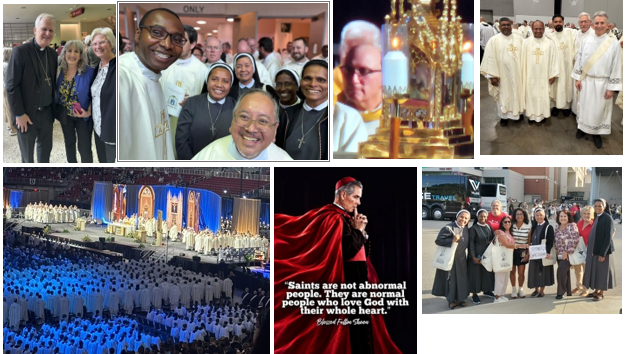
Why a Eucharistic Congress Matters for the Life of the Church 
By Deacon Dan Vaughn July 21, 2026
A couple of weeks ago a friend of mind was having a ‘spirited’ discussion with a friend regarding the ‘saintliness’ of St. Christopher. His friend argued that St. Christopher is no longer considered a Catholic saint due to the lack of credible information surrounding his life. The timing of the question was quite good as St. Christopher’s feast day is on July 25, the same as St. James the Apostle. Now the rest of the story… St. Christopher is one of the most beloved figures in Catholic devotion. A martyr of the third century, almost nothing certain is known historically about his life yet the Church has never stopped honoring him. A church built in the early 450s in Bithynia (modern-day Turkey) provides early testimony to his veneration, as does ecclesiastical evidence from the 500s and 600s. The Name: His very name says everything. From the Greek Christos (Christ) and pherein (to bear), Christopher literally means Christ-bearer - a name that perfectly captures his legendary mission and his call to every Christian who venerates him. The Legend: Christopher was a man of extraordinary size and strength who resolved to serve only the greatest master. He served a mighty king, then the devil himself but found both lacking in true courage. A hermit eventually pointed him toward Christ, instructed him in the faith, and baptized him. Seeking to serve, Christopher stationed himself at a dangerous river crossing and carried travelers safely to the other side. One day, a small child asked to be carried across. With each step, the child grew unbearably heavy, as though Christopher bore the weight of the entire world. The child revealed Himself as Jesus Christ, the Creator and Redeemer, and the crossing became a moment of divine encounter. His witness led to many conversions, which enraged the local pagan king. Christopher was imprisoned, tortured, and beheaded a martyr's death. Even in death, his blood miraculously cured the king's blindness, prompting his conversion. Patronage: St. Christopher is the patron saint of travelers, motorists, sailors, pilgrims, and all who journey far from home. He is counted among the Fourteen Holy Helpers (a topic for a future article). His image was traditionally placed at church entrances, bridges, and city gates, a guardian for those setting out into the unknown. Was He "De-Canonized"? No. After Vatican II, a commission reviewed the liturgical calendar and removed feast days of a number of saints whose historical record was more legendary than provable. But this was never a de-canonization. The Church cannot "un-saint" someone . Christopher remains a saint. His feast on July 25 may still be celebrated by parishes and by the faithful with enduring devotion to him. The Deeper Truth: Christopher's story is more than a pious legend; it is a mirror held up to every baptized Christian. The raging river, the unbearable weight, the hidden presence of God in what seemed like an ordinary act of service, all of it speaks to the Christian life. Every soul is called to be a Christophorus: a bearer of Christ into the world. He didn't know he was carrying Jesus. Neither do we, most of the time. Christopher carried a stranger across a dangerous river and discovered it was Jesus. Where in your daily life might Christ be disguised as the heaviest burden you're being asked to carry?
By Deacon Dan Vaughn July 14, 2026
Bishop Rice’s homily highlights from last weekend’s Steubenville Youth Conference
By Deacon Dan Vaughn July 6, 2026
The past week brought significant developments concerning the Society of St. Pius X (SSPX), and it seemed appropriate to provide a clear account of what happened and why it matters to the Church. Who Are They? The SSPX is a priestly fraternity founded in 1970 by Archbishop Marcel Lefebvre. It is known for its exclusive use of the Traditional Latin Mass and its rejection of several teachings of the Second Vatican Council, especially on religious freedom and the Church’s relationship with other faiths. For decades, the society has lived in tension with Rome, sometimes drawing closer, sometimes pulling away. A History of Rupture. The major break occurred in 1988 when Archbishop Lefebvre consecrated bishops without papal approval. Under canon law, this act incurred automatic excommunication for him and the bishops he consecrated. Pope Benedict XVI lifted those excommunications in 2009 as a gesture of reconciliation, though the society remained outside full communion. In 2015, Pope Francis extended special faculties to the SSPX to allow its priests to validly hear confessions, and in 2017, he granted it faculties to allow its priests to validly celebrate marriages. Rome extended mercy at every turn. What Just Happened? Despite direct warnings from the Vatican, the SSPX proceeded on July 1 with the consecration of four new bishops without a papal mandate. Pope Leo XIV personally appealed to them not to proceed. Vatican officials called the act “schismatic,” and on July 2 declared that the six bishops involved had incurred automatic excommunication and that SSPX clergy “are in schism and therefore must be considered schismatics.” What Is This Really About? Many assume the conflict centers on the Latin Mass. It does not. The Church has repeatedly affirmed the beauty and legitimacy of the ancient rite when celebrated in communion with Rome. The deeper issue is the SSPX’s rejection of the authority of the Second Vatican Council. The society argues that because Vatican II issued no new dogmas, its teachings need not be fully accepted. The Church firmly rejects this claim. Vatican II’s documents belong to the Church’s authentic magisterium, and Catholics owe them religious submission of mind and will. Love for tradition is good, but it cannot override obedience to the successor of Peter. Communion with Rome is essential to being Catholic. Can Catholics Attend SSPX Masses? The Vatican acknowledges that attending an SSPX Mass does not automatically excommunicate a Catholic, provided there is no “formal adherence” to the schism. This means avoiding both internal agreement with the society’s rejection of Rome and external behaviors such as exclusively attending SSPX chapels. However, Catholics seeking the Traditional Latin Mass (TML) are strongly encouraged to find communities celebrating in full communion with Rome. They exist and they offer all the beauty of the ancient rite without spiritual risk. In our diocese, TLM is celebrated on Sundays at 8:00 am at the O’Reilly Catholic Student Center – Missouri State University. The Door Remains Open. The Church continues to welcome those who wish to return. Any SSPX priest or faithful seeking reconciliation should reach out to a local diocese. The path back exists, and it begins with turning toward Peter. "Where the bishop is, there is the Church." — St. Ignatius of Antioch

Hey Deacon !